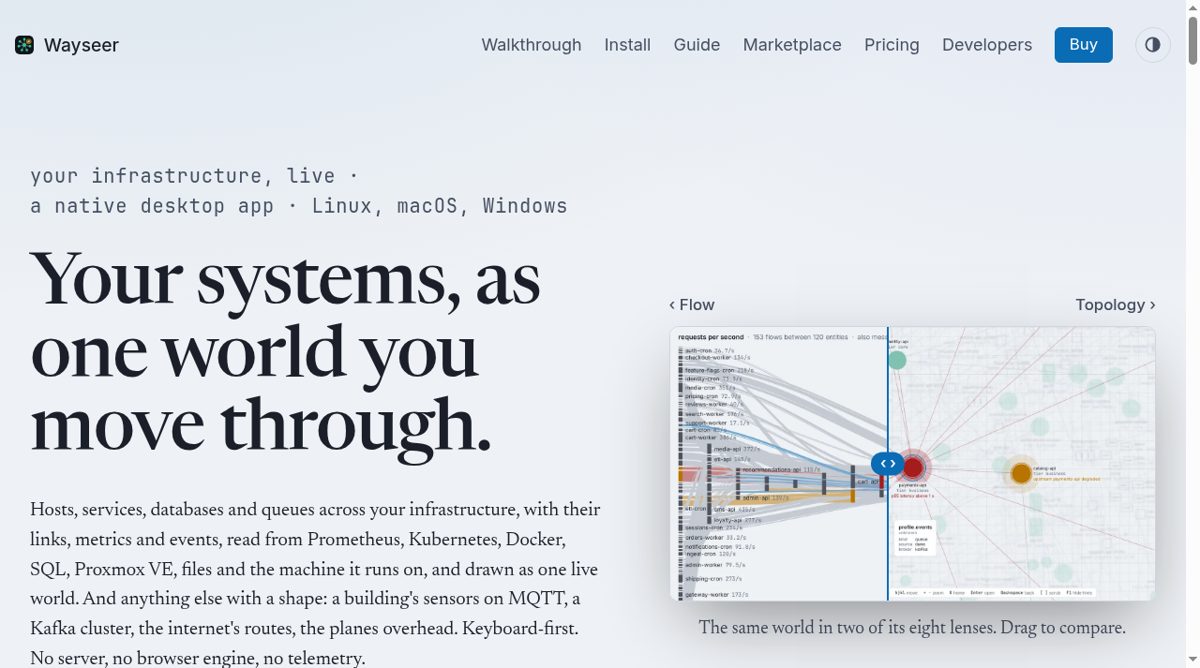
Wayseer is a native desktop application for exploring infrastructure as a connected visual world. It brings hosts, services, queues and other entities together with their relationships, metrics and events. The homepage shows topology, flow and timeline views, with focus and filters carried between views. It targets Linux, macOS and Windows and is designed around keyboard navigation rather than a browser-based hosted dashboard.
The free download includes files, the local machine, Prometheus, Docker or Podman and Proxmox VE sources. A paid license adds features including Kubernetes, SQL schemas and queries, modules, multiple windows, a control socket and language-model interaction with a configured provider. These are meaningful limits: the homepage's full integration list is not the same as the free entitlement. SQL statements are described as read-only. Configured Kubernetes changes require explicit confirmation in the application rather than being an automatic consequence of viewing a cluster.
The pricing page lists US-dollar personal licenses at $50 a year for noncommercial use and business licenses at $200 per person per year, including paid or freelance work. It describes automatic annual renewal until cancellation, while releases built during a covered year remain usable with that key afterward. License checks happen locally according to the vendor. The app's no-telemetry claim should not be confused with never connecting anywhere: live data sources and an optional language-model provider necessarily have their own connections. Wayseer is most useful when seeing relationships and changes together is more helpful than reading isolated metric panels.