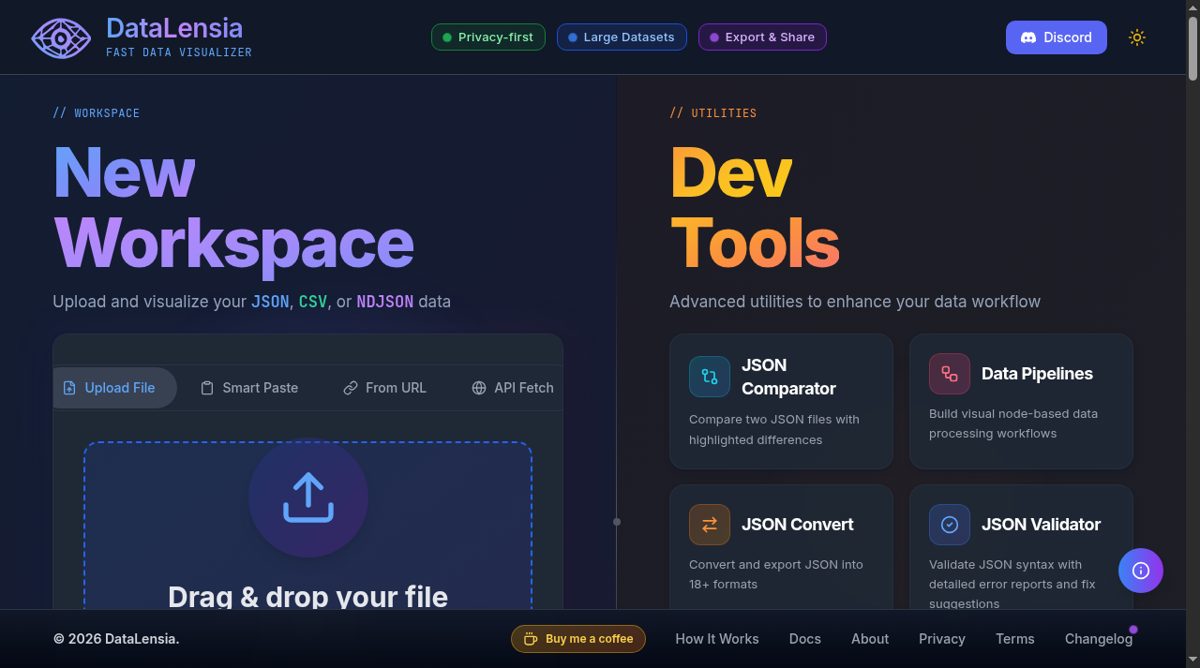
DataLensia is a browser-based workspace for exploring structured data and using JSON-focused developer utilities. The main interface accepts files, pasted content, a URL or an API request, with JSON, CSV and NDJSON named as supported inputs. A visitor can start from sample data or reopen a saved workspace. The site describes automatic format recognition, tabular and tree exploration, filtering, sorting and field-level statistics for inspecting the shape and contents of a dataset.
The developer tools include a JSON comparator, syntax validator, format converter, schema generation and a JSON-to-Mermaid diagram route. A visual pipeline interface supports arranging data-processing steps, while a mock JSON API tool provides another route for testing integrations. Conversion targets described on the site include common structured formats, SQL statements and programming-language types. Charts and diagram exports can help turn an inspected structure into documentation, but a generated schema or inferred type still needs review against real edge cases.
DataLensia makes an important distinction between local file work and features that communicate externally. Core file operations are described as browser-side processing without a DataLensia file-processing backend. The site separately discloses usage analytics, and shared URLs, mock endpoints, API fetching and optional GitHub synchronization can transmit data. A user working with confidential records should consider those boundaries rather than assume that every feature is offline. Browser memory and file complexity also affect practical capacity; large-dataset marketing is not a promise that every file will fit. DataLensia is useful for inspection, conversion and documentation, with final output and privacy choices remaining part of the user's workflow.